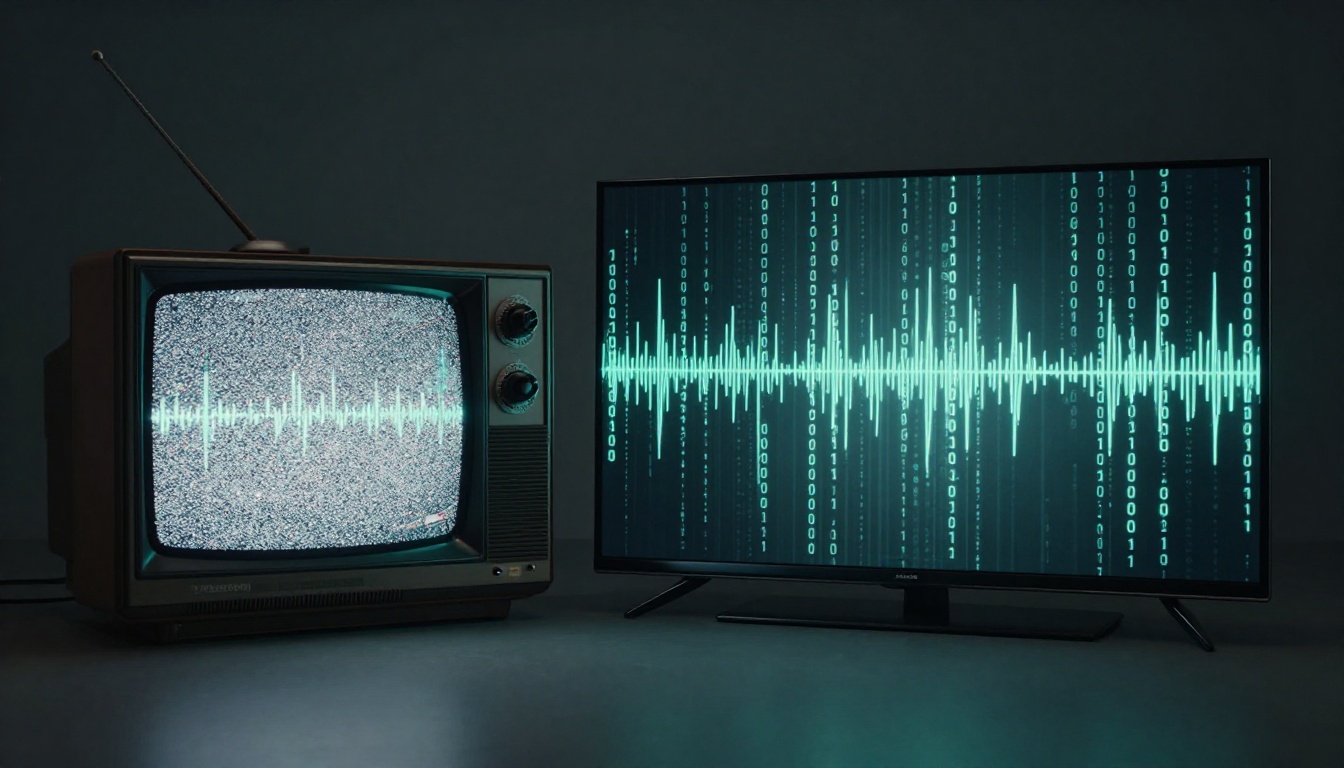
Have you ever watched an old channel and thought, “Why is this picture covered in snow”? It’s a familiar kind of frustration. Meanwhile, modern TV looks crisp even when the room lighting changes. That contrast comes down to the difference between analog and digital TV.
Analog TV sends video and sound as continuous radio waves. If interference hits the signal, the picture gets worse. You often see noise, ghosting, or a snowy screen.
Digital TV works differently. It turns audio and video into data, then sends it as numbers. Your TV decodes that data into a clear picture, or it fails more abruptly.
In the US, most over-the-air analog broadcasting ended in 2009, and by 2026 digital dominates. Cable and satellite never used analog over the air in the same way. Still, people keep asking because some TVs, antennas, and adapters can feel confusing.
So, what’s the real difference between analog vs digital TV signals? Keep reading to see how each system sends its “information,” why the picture looks different, and what it means for your setup today.
How Analog TV Works Versus Digital Signals
Analog and digital both move video and audio from a tower to your TV. But they don’t “ride” the airwaves the same way.
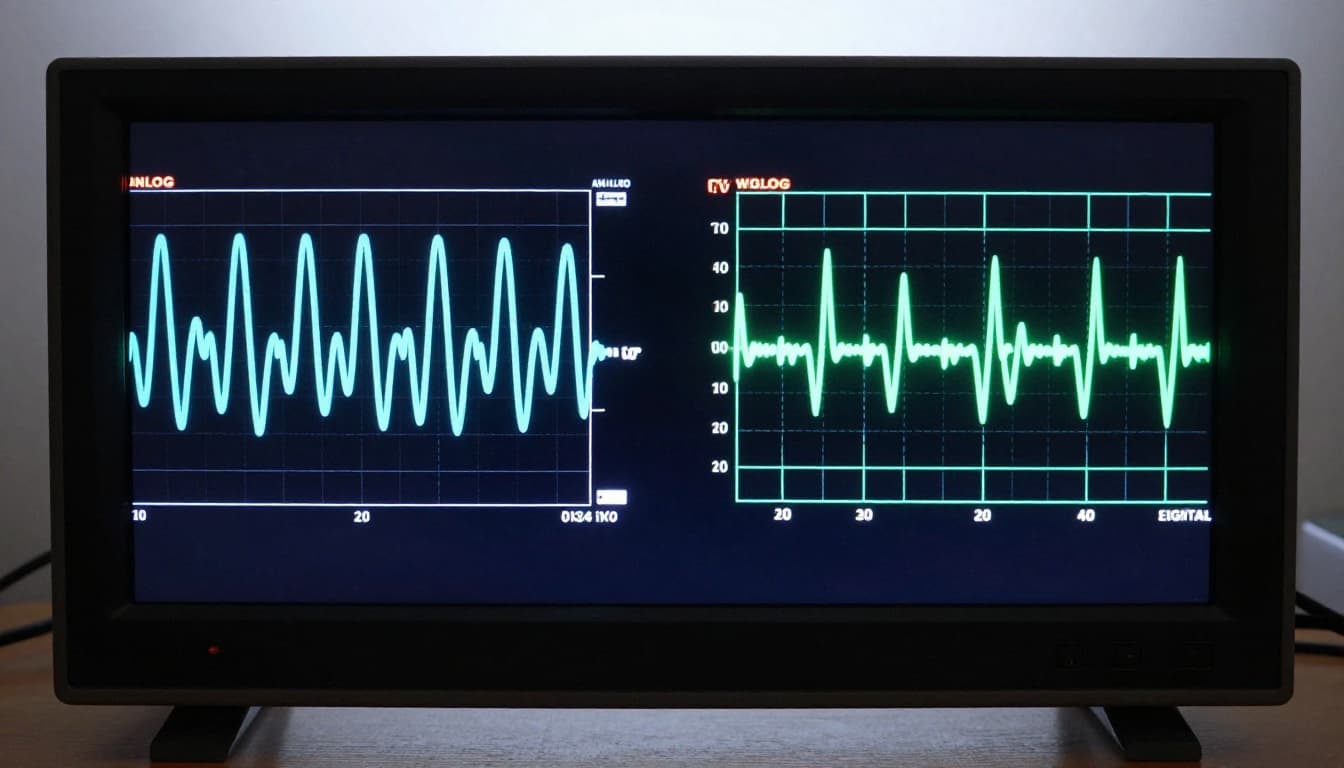
Think of analog like a smooth road. The signal continuously changes as it carries the image and sound. When conditions shift, the signal shape shifts too. That’s why old broadcasts could look fuzzy and thin, especially with bad reception.
Think of digital like on-off switches. It breaks the content into chunks and sends it as data. Your TV rebuilds the full picture from those bits. Error correction helps it stay stable, even if the signal weakens.
A quick, helpful way to see the core idea is to compare how each system represents information. Analog TV transmits continuous waves, while digital TV transmits encoded data that a receiver reconstructs. This overview of the analog-to-digital difference also explains why interference affects analog more. See analog signal TV vs digital TV for a clear breakdown.
Now let’s zoom in on how the two systems move those signals.
The Simple Wave of Analog Broadcasting
Analog TV broadcasting sends radio waves that mimic the content. The tower transmits signals that map to the picture and audio in a continuous way. As a result, the TV can display the image “as it arrives,” without turning it into computer-style data first.
In practical terms, analog TV used tuned channels. A channel number corresponds to a frequency range. Older TVs used a tuner and filters to lock onto that range. Once tuned, the TV adjusted for the broadcast’s analog waveform.
Because the signal is continuous, analog systems also show gradual degradation. When reception gets worse, you might first notice softer image detail. Then you might see stronger ghosting. If the signal drops enough, you’ll get heavy “snow” or even a near-black screen.
This is why analog often behaved like AM and FM radio. Great reception sounds clean. Weak reception sounds distorted. TV follows the same pattern. Cable, satellite, and low-power broadcasting could still be affected by signal quality issues, but the over-the-air feel was the most obvious.
So analog could be simple and forgiving when signals were decent. However, it had a hard time staying clean through noise and distance.
Digital’s Smart Packet Delivery System
Digital TV encodes the content into data. Instead of sending the picture wave “as-is,” the station converts it into bits. Then it transmits those bits using a digital modulation method.
Your TV receives the modulated signal. Next, it performs decoding and error checks. If enough of the data arrives correctly, the TV reconstructs the show. That’s why digital can look perfect until it suddenly can’t.
This “almost perfect, then fail” behavior is called the cliff effect. It’s a normal result of error correction working until it can’t. After that point, the TV may go blank or show severe artifacts.
Digital also tends to use spectrum more efficiently. That efficiency can support higher resolution formats and multiple sub-channels. It also makes it easier to add modern audio features and program services.
If you want a wider comparison of how signal encoding and bandwidth change between old and new systems, this guide is useful: difference between analog TV and digital TV.
In short, analog carries an image as a continuous signal. Digital carries an image as data your TV rebuilds.
Picture and Sound: Spot the Real Differences on Your Screen
Once you know the signal story, the picture differences make sense. Analog struggles because it’s exposed to noise. Digital survives because it corrects errors and rebuilds from data.
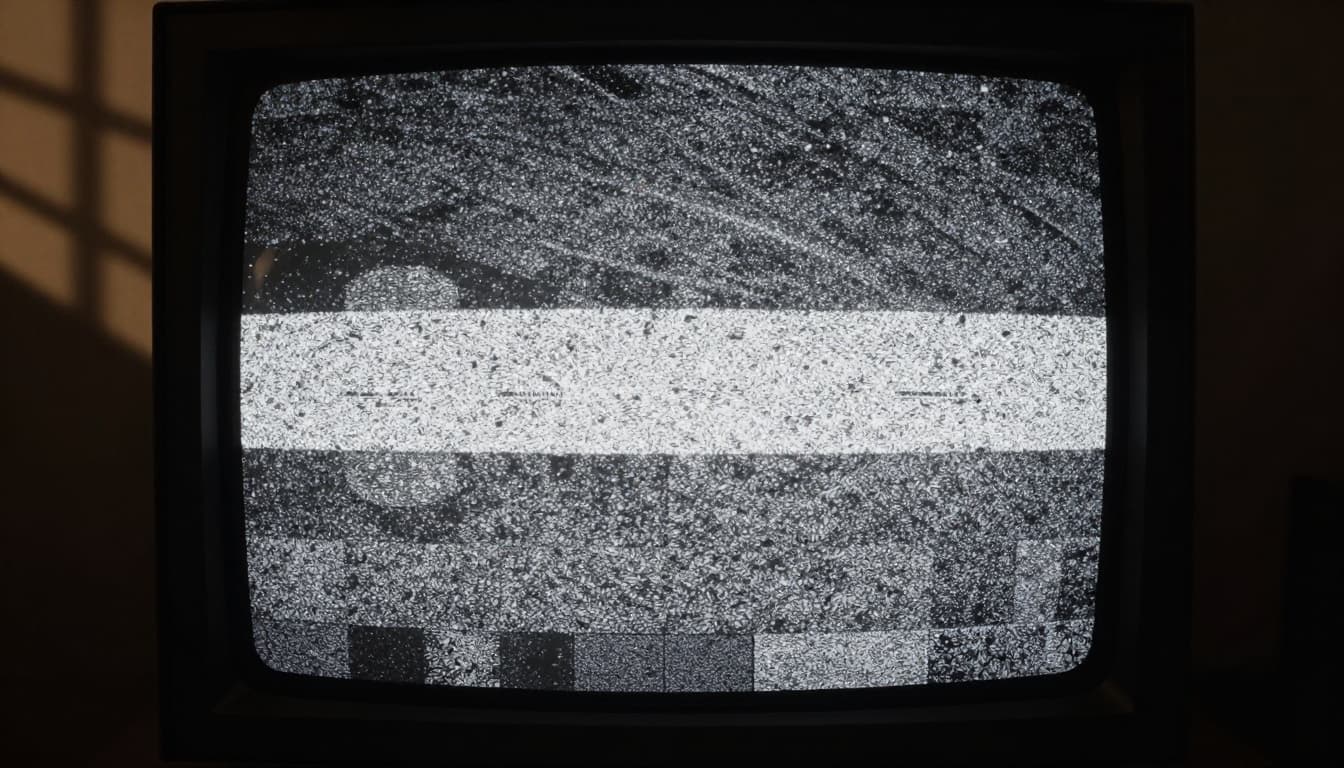
On analog TV, interference often shows up as visible distortions. You might see ghost images, smeared edges, or the classic snowy texture. Motion can look messy too. When a scene changes quickly, analog can’t “lock” detail the same way a digital decoder can.
Digital TV usually looks sharper because it delivers more consistent information. Many broadcast formats support HD. Some setups also support 4K through newer standards and services. The audio can improve too, with clearer voice and more accurate sound staging.
Here’s the easiest mental model: analog gives you a “live drawing” of the signal. Digital gives you a “rebuild job.” If the rebuild works, the result looks clean.
Analog visuals: snow, blur, and ghosting
A good example is an old set connected to an indoor antenna. When you move the antenna slightly, the picture changes fast. You’ll see snow if the signal is weak. You might also see ghosting, where part of the image seems to double.
That’s not just your eyes playing tricks. Analog video is sensitive to amplitude changes and timing errors. Add multipath signals (like the same wave bouncing off buildings), and the picture can turn messy.
Digital visuals: sharp detail until the signal drops
Digital pictures often hold steady longer. If your antenna or cable feed gets a strong enough signal, the TV decodes the stream and outputs a clean image.
When the signal gets too weak, you usually won’t get the same “snowy middle stage” you see with analog. Instead, the image quality may suddenly break down. Sometimes you’ll notice blocky artifacts or a full loss.
Audio is similar. Analog sound can pick up hiss and distortion. Digital sound is typically clearer. It can also support better surround sound options, depending on the broadcast and the TV.
In everyday viewing, the difference feels huge. An old VHS tape compared to streaming often hits the same contrast. VHS has real-time analog noise. Streaming benefits from digital encoding, buffering, and error-handled delivery.
In a modern living room, that clarity stands out. Here’s what it tends to look like when the signal works.
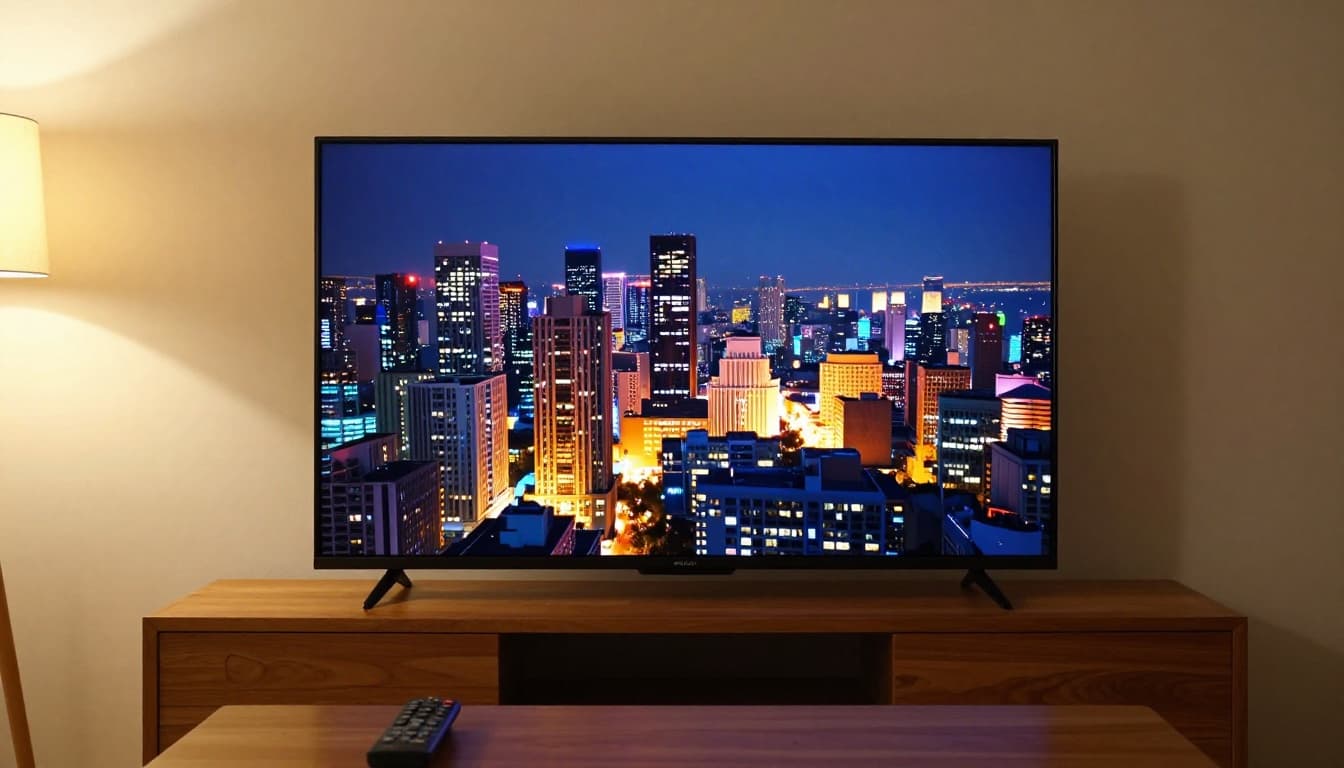
Bottom line: Analog often degrades gradually. Digital stays clean longer, then drops when it can’t decode.
Pros and Cons: Which TV Tech Wins for You?
If you’re asking “Which is better?”, digital wins for most viewers. Still, analog isn’t useless in every sense. It also helps explain why certain older TVs can still work in limited ways.
The real question is: what do you have, and how do you watch? Over-the-air antennas, cable boxes, and streaming apps each change the answer.
To compare the two systems, here’s a simple take:
| Feature | Analog TV | Digital TV |
|---|---|---|
| Signal type | Continuous waves | Encoded data (bits) |
| Picture quality | Often fuzzy or distorted | Often sharp (HD and beyond) |
| Noise behavior | Gradual snow and ghosting | Error correction, then cliff effect |
| Channels/sub-channels | Limited | Can support more services |
| Gear needs | Older tuners | Digital tuner or converter (varies by TV) |
| Usability in 2026 | Mainly legacy | Mainstream over-the-air standard |
Reasons Analog Still Feels Nostalgic
Analog TV feels comforting for a few reasons. First, the experience can feel “direct.” You tune, you watch, and the signal changes right away. When you’re chasing the best picture, you can feel the antenna adjustment as an immediate reward.
Second, older sets can run without complex setup. If you already own a vintage TV and you can still receive an analog source through special setups, it may work without extra gear. That “no fuss” feeling sticks.
Also, analog broadcasts can be forgiving in a weird way. Even when the signal isn’t great, you still see something. With digital, you might get nothing at all once the signal drops below a threshold.
However, analog has real limits. Resolution is typically lower, and distortion can ruin fine details. Plus, the number of analog broadcast options is now tiny.
Why Digital Changed TV Forever
Digital TV changed what broadcast TV could offer. Because digital can carry more structured data, stations can deliver sharper video and better audio. That opened the door to widescreen formats, HD channels, and multiple program streams.
Digital also made upgrades more practical for stations. When a station can improve encoding or services, viewers may benefit without replacing every tower and antenna overnight.
Most importantly, digital made TV more dependable for daily life. You don’t want to fine-tune your antenna every time the weather shifts. Digital helps keep the picture stable across normal day-to-day changes.
In 2026, digital is the baseline expectation. If you’re shopping for a TV, you’re also shopping for digital decoding support. You might still see mentions of older standards in listings, but most modern sets assume digital over-the-air reception.
The Switch to Digital TV: History and 2026 Updates
The US transition to digital TV is one of those events that happened quietly for most people, then suddenly mattered. Full-power analog over-the-air broadcasts stopped on June 12, 2009. After that date, viewers needed digital reception to watch major channels.
If you want a closer look at the US switchover, Nielsen covered how the change was handled and how many homes were ready before the final analog shutoff. Read the switch from analog to digital TV.
For a wider timeline and background across the country, Wikipedia also summarizes the transition and the key dates. See June 12, 2009 U.S. transition.
Now fast-forward to 2026. Over-the-air analog is effectively gone in developed areas. Instead, the focus is on the next upgrade for digital broadcasts.
In the US, the new standard is ATSC 3.0, often called NextGen TV. It can carry improved picture quality and added features like enhanced emergency alerts. It also supports more modern services while staying compatible through station strategies.
Current rollout is active but not fully “everywhere, always.” As of early 2026, about 75% of US viewers can reach ATSC 3.0 through stations broadcasting it in many markets. Many broadcasters run both ATSC 3.0 and the older ATSC 1.0 during a transition period.
So, if you’re thinking about the difference between analog and digital TV, you’re also seeing the next chapter. Digital didn’t just replace analog. It gave broadcasters a way to add features that analog never could.
Conclusion: The Real Difference You Feel Every Day
Analog TV sends continuous signals and shows problems as they happen. Digital TV sends encoded data, rebuilds the picture, and stays clear until it cannot decode. That’s the core of the difference between analog and digital TV.
In 2026, digital is the practical choice for most people. If your goal is a stable, clean picture and clear sound over the air, you want the digital setup (and often the newer ATSC 3.0 experience where available). Analog nostalgia is real, but it’s mostly a memory.
If you still use an older TV, check what kind of tuner it has and whether you need a converter for over-the-air broadcasts. Then ask yourself: does your current setup hold a steady picture, or does it drift into snow?
When you compare what you see now to the fuzzy past, the signal difference stops being a theory. It turns into your next “why is this blurry?” answer.