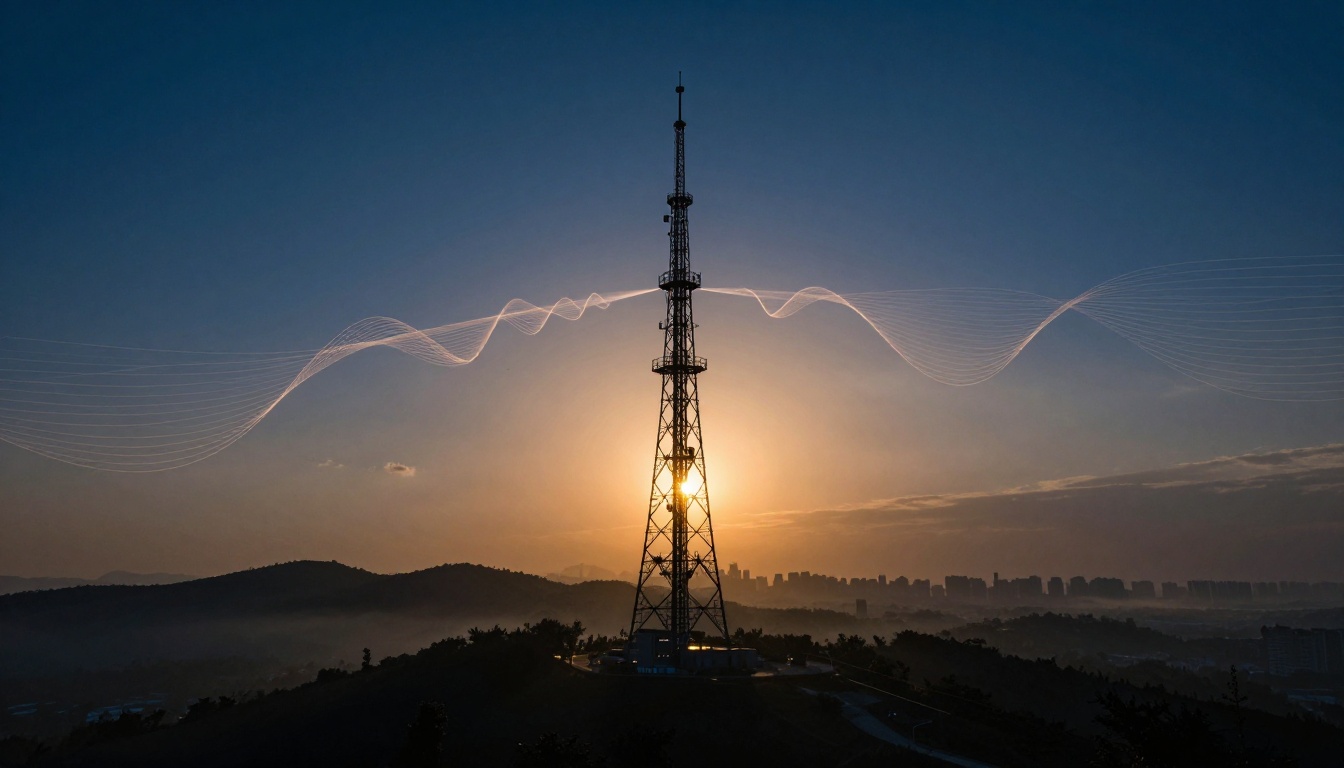
You’ve probably heard it before. You tune your radio, and suddenly a station you expected to be “too far away” comes in clearly. Or you flip on TV and get a channel that feels like it should only reach someone across town.
That magic comes from broadcast towers sending radio signals that can travel far beyond what you’d guess from the height of a single building. At the same time, it’s not one single trick. Radio signals spread using different paths, like line-of-sight, ground waves, and skywave bouncing.
Physics sets the rules. The signal strength changes with distance, frequency, and the real world in between, including weather and terrain. Then modern towers add better transmitters, smarter antennas, and more ways to back up or extend coverage.
So how do those signals actually make the trip?
The Simple Science Behind Creating Radio Signals
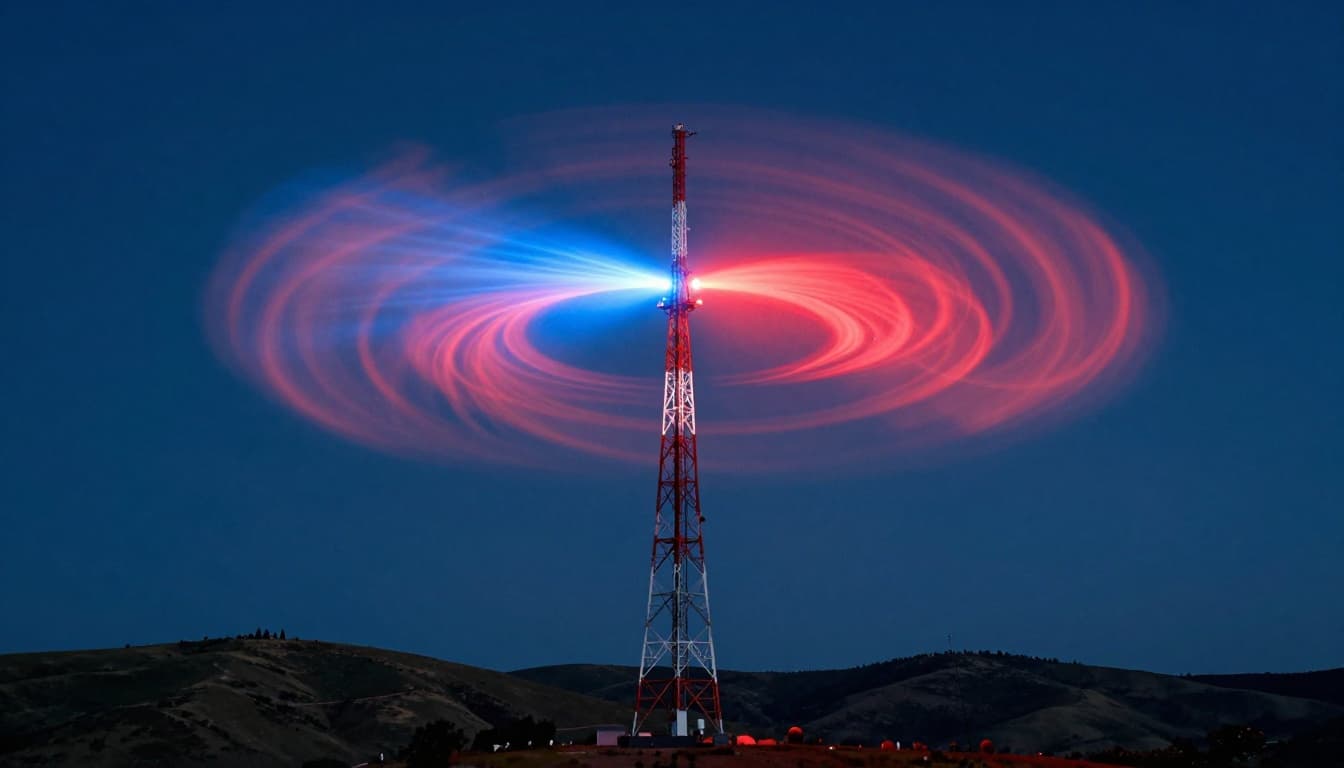
Think of a radio tower like a giant “wave maker.” When the station’s transmitter sends power to the antenna, electricity changes at a huge speed. That rapid change makes the antenna push and pull on electric charges, which creates waves of electric and magnetic fields.
Those fields travel through the air at nearly the speed of light. In plain terms, you’re not sending sound or video through the air directly. You’re sending a signal that represents sound or pictures. Your receiver then recreates the original content.
Now, how does the tower turn music and voice into something radio can carry? It uses modulation, which is a fancy word for “putting information onto a radio wave.”
- In AM radio, the station changes the radio wave’s amplitude, or height.
- In FM radio, the station changes the wave’s frequency, or speed.
The receiver constantly watches those changes. Then it converts them back into sound.
For TV, the idea stays similar. The station forms a radio signal that includes the information for a picture and sound, plus data needed for modern over-the-air reception.
Here’s the key point: the tower doesn’t just “broadcast.” It creates a repeating electromagnetic pattern, then shapes it so more of that energy goes where people live.
A helpful analogy is pond ripples. Drop a stone, and you get waves moving outward. The transmitter is the stone, the antenna is the wave maker, and the spreading pattern is how the signal covers distance.
If you want a clear visual breakdown of different propagation paths, this overview of radio wave propagation types can help: Types of radio wave propagation – QSL.net.
Still, even perfect signal creation won’t help if the path fails. Next, let’s look at the main ways radio waves reach far receivers.
Four Ways Broadcast Signals Travel Long Distances
Radio propagation is what happens after the wave leaves the tower. Four major paths show up again and again in broadcast planning, listening experiences, and “why did this station suddenly come in?” moments.
Each path depends on frequency, the time of day, the atmosphere, and the ground. So the same tower can cover differently from morning to night.
Line-of-Sight: The Straight-Shot Path for TV and FM
For many TV and FM stations, radio waves mostly behave like light. They move in straight-ish lines until they hit something that blocks them, like buildings, hills, or trees.
Because Earth curves, the usable range depends on the height of the transmitting and receiving antennas. This is why stations place antennas high on towers or mount them on tall hills. Even a modest height increase can make a noticeable difference.
In real-world planning, line-of-sight coverage often aims for distances that feel “around town,” plus the extra reach from height. If you’ve ever seen TV reception improve when you move an antenna higher, you’ve already seen the line-of-sight effect.
A simple way to picture it: if you can’t see the tower, the signal can get weaker fast. Of course, this isn’t a perfect rule, because real signals also refract and scatter. But it’s close enough to understand why line-of-sight matters.
Relay sites help too. If a valley blocks the path, a station can send the signal to another higher location, then broadcast again from there.
Ground Wave: Following the Ground for AM Radio
AM radio often uses a different superpower: ground wave propagation. With lower frequencies, part of the energy hugs the Earth’s surface. It can follow the curvature far better than line-of-sight signals.
Ground waves work best when the ground conducts electricity well. Over seawater, for example, signals often travel farther than they do over rocky or dry soil. Also, lower frequencies tend to ride the surface more effectively.
This is why you may get steady AM reception across wide flat areas, especially during the day. Even when skywave kicks in later, ground wave still plays a role.
So when an AM station sounds consistent over long distances, ground wave is often one reason.
Skywave: Sky Bounces for Cross-Country Reach
At night, the sky can help a lot. Some radio waves travel upward and then reflect off charged layers in the upper atmosphere (the ionosphere). That reflection can bounce the signal back toward Earth.
This is skywave propagation, and it’s famous for long-distance AM reception. If you’ve ever tuned the dial after dark and heard stations from far away, skywave is usually behind that “how is that possible?” moment.
Daytime conditions often absorb more of these lower-frequency signals. At night, that absorption can drop, and the ionosphere reflects better. As a result, skywave range can jump dramatically after sunset.
Tropospheric Ducting: Weather’s Rare Long-Range Boost
Sometimes the atmosphere acts like a funnel. Changes in temperature and humidity can create layers that guide radio waves, bending them farther than normal.
This effect often shows up with certain weather patterns and can create sudden, temporary long-distance reception, especially at VHF and UHF. It’s unpredictable, so it’s a favorite among people who enjoy “DX” listening (finding distant stations).
Ducting can turn a normal reception night into a rare one. Then, it disappears when the air conditions change.
Key Factors That Stretch or Shrink Signal Range
Even with the right propagation path, distance isn’t automatic. Several factors decide whether the signal reaches you strongly or fades out.
Most importantly, the frequency sets the “starting behavior.” Low frequencies tend to support ground and skywave. Higher frequencies often depend more on line-of-sight.
Next comes power and antenna height. Higher power increases strength, but it doesn’t override physics. Height also matters because it improves the horizon and reduces blockage. Antenna direction also plays a role. Many stations use directional antennas to focus energy where they want it, like toward cities and away from water or neighboring coverage areas.
Finally, the ground and the weather influence real performance. Wet soil, smooth terrain, and certain atmospheric conditions can help. Mountains, dense buildings, and rain can hurt.
Here’s a quick comparison of how the main paths usually stack up:
| Propagation method | Typical frequency use | What limits it most | Best conditions |
|---|---|---|---|
| Line-of-sight | VHF/UHF (TV, FM) | Earth curve, obstacles | High antennas, clear paths |
| Ground wave | Lower-frequency AM | Ground conductivity | Water and flat terrain |
| Skywave | Lower-frequency AM | Time and ionosphere | Nighttime reflection |
| Tropospheric ducting | VHF/UHF | Weather layers | Temperature inversions |
The takeaway is simple. Range comes from matching the signal to the path that can actually reach your area.
If you want a practical angle on how line-of-sight limits range and why antenna height matters, this guide is useful: Line of sight radio range & antenna heights.
Today’s Tech Making Signals Go Even Farther
Towers still matter. But they’re no longer the only piece of the system doing the heavy lifting. Today, broadcast engineering focuses on more reliable delivery, better use of spectrum, and backups when networks or links struggle.
In the US, the big over-the-air upgrade is ATSC 3.0. It brings improved picture and sound, and it also supports extra features like data services. If you’re tracking how ATSC standards keep moving, ATSC posts updates on its practices and changes, such as this item on a newly published recommended practice: ATSC standards update from ATSC.
Beyond the tower itself, broadcasters also use modern workflows to get content to transmitters. As of March 2026, industry updates point to stronger mixing of over-the-air broadcasting with IP-based transport, plus live delivery options like public cellular networks when fiber fails. Secure Reliable Transport, or SRT, also shows up as a common way to move low-latency video reliably over IP links.
Also, 5G broadcast testing has been expanding. The goal isn’t just “higher speed.” It’s dependable delivery for alerts, first responders, and mobile viewers, especially where traditional delivery can be less flexible. Those trials matter because they can help the station reach more people when conditions change.
In other words, towers aren’t alone anymore. The broadcast system now includes studio-to-transmitter links, redundancy paths, and receiver standards. That means your signal experience gets better not only from radio propagation, but from how the station sends and safeguards the content before it even reaches the antenna.
Conclusion
Broadcast towers send signals over long distances by creating electromagnetic waves and then letting the environment decide the path. Modulation carries sound and video information, and radio propagation picks the route, whether that’s line-of-sight, ground wave, skywave, or tropospheric ducting.
Range changes because frequency, power, antenna height, terrain, and weather all shift the result. Modern broadcast tech also helps, especially through ATSC 3.0 improvements and stronger delivery methods that back up the signal before it hits the tower.
Next time you catch a distant station, ask yourself what path you’re probably hearing. Then try it again at a different time of day. You’ll notice how the invisible “trip” changes, and that’s where the real wonder starts.