Ever caught a car radio in a rough mood? You switch bands, and suddenly the music sounds clean on FM, but on AM it turns into static and mush. That quick change feels random, but it’s not.
AM and FM are two main ways radio stations send sound through the air. They use different signals, which changes what you hear. You’ll notice it in sound quality, how far stations reach, and how badly storms or power lines mess things up.
This guide breaks down the differences in plain English. You’ll learn how AM and FM encode sound, why FM usually sounds better, when AM can travel farther, and what still matters in 2026. Next time you tune the dial, you’ll know which band fits your trip.
How AM and FM Encode Sound Signals Differently
Think of radio waves like ocean waves carrying a message in a bottle. The station’s job is to “shape” those waves so your radio can decode the message as sound.
Both AM and FM start with a carrier wave. Then they change one part of it using the audio from the station. In other words, they “ride” the carrier differently so the listener hears voices, music, or sports.
A simple way to remember it:
- AM (amplitude modulation) changes the wave height to match the audio volume.
- FM (frequency modulation) changes the wave frequency to match the audio.
One technical overview explains it this way: AM adjusts the carrier wave amplitude, while FM adjusts the carrier wave frequency. For more background, see FM vs AM technical differences.
AM’s wave behavior (height changes)
In AM, louder parts of the audio make the carrier wave taller. Softer parts make it shorter. Your radio looks at that height pattern and turns it back into sound.
That matters because AM lives in the 535 to 1,705 kHz range. These lower frequencies can travel well over land. They can also bounce at night, which we’ll cover later.
FM’s wave behavior (frequency changes)
In FM, the carrier wave amplitude stays steady. Instead, the station shifts the carrier’s frequency up and down as the audio changes.
FM stations use the 88 to 108 MHz range. Those higher frequencies support better sound quality because the station can send more audio detail.
Here’s why listeners care: AM and FM also differ in how much audio they can carry well. FM typically supports much wider audio bandwidth (often up to around 15 kHz). AM is usually limited to roughly a few kHz, which is why AM often sounds flatter.
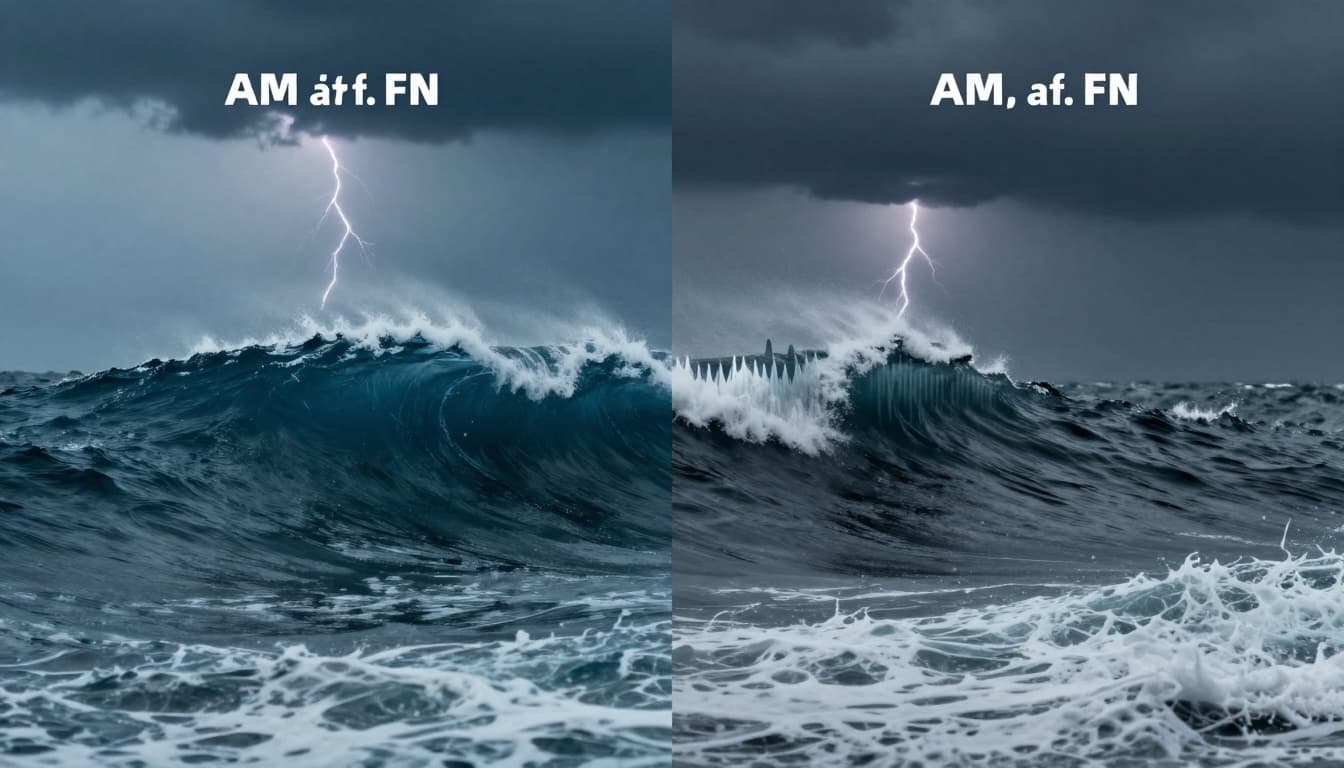
In short, AM and FM “write” the audio onto the carrier in different ways. Next, let’s zoom into each band so the sound differences make sense.
AM Radio: Riding the Waves of Changing Height
AM signals change the amplitude of the carrier wave. That means your radio has to track small height changes. When everything is clean, it works fine.
AM often fits best for formats like:
- Talk radio
- News
- Sports updates
- Weather announcements
That doesn’t mean AM can’t carry music. It just means the audio details often get lost. AM also tends to feel more “thin,” especially during playback over a built-in car speaker.
Here’s a quick analogy. Imagine you’re trying to get someone to hear you in strong wind. You shout louder when the message needs emphasis. That’s like AM. The “volume of the wave” changes with the audio.
This approach also helps AM pack more stations into its band. Since AM uses lower frequencies and different channel spacing, the dial can fit many options. However, the tradeoff is that the signal processing and audio limits make rich sound harder to maintain.
FM Radio: Shifting Speeds for Smoother Sound
FM signals change the frequency of the carrier, not the height. When the audio rises or falls, the carrier’s pitch changes, too.
So instead of “shouting louder,” FM changes how fast the wave cycles. Your radio then reconstructs the original audio from those frequency swings.
Because of the way FM supports wider audio bandwidth, music usually sounds more detailed. You can often hear more high notes and subtle sound layers. Even everyday listening feels smoother.
Think of a steady drumbeat. On FM, the “timing” of the carrier shifts with the audio pitch changes. That lets the receiver build a fuller audio picture.
Another reason FM feels more stable is how it handles noise. Most random interference messes with amplitude more than frequency. Since FM doesn’t rely on amplitude changes as much, the signal stays cleaner in many real-world conditions.
Up to this point, you know what changes in the signal. Now you can connect it to what you actually hear on your drive.
Sound Quality, Range, and Static: Where AM and FM Really Diverge
When people say AM sounds “fuzzy,” they’re usually describing the real-world combo of signal limits plus noise sensitivity. FM often sounds clearer because it carries more audio detail and resists many common interference types.
Also, range is not the same thing as clarity. A station can be far away and still sound decent, or close and still sound rough. The band affects both.
If you want a broader, reader-friendly comparison, AM vs FM radio differences gives a useful overview of what people notice day to day.
Here’s a quick side-by-side look at the big differences.
| Factor | AM | FM |
|---|---|---|
| Typical sound feel | Flatter, more “talk radio” | Clearer, more “music ready” |
| Best use | News, talk, long-range reach | Music, stereo, local stations |
| Range in daytime | Often fewer miles | Usually about 30 to 50 miles |
| Range at night | Can jump much farther | Limited by line of sight |
| Common issue | Static that sounds like fuzz | Less noise, but can cut out |
Now let’s break down each part so it clicks.
Why FM Delivers That Crisp Music Experience
FM can carry more high-frequency audio. That’s why vocals sound more natural, and instruments sound less “sanded down.”
It also opens the door for stereo broadcasts. Stereo matters because music feels wider. You hear separation between instruments and voices.
On AM, stereo broadcasts exist in some systems, but most AM experiences feel more mono and less detailed. Even when a station is clear, it often sounds thinner than FM.
Here’s a simple way to picture it. If AM is a sketch, FM is the finished drawing with more lines. The station’s content still matters, but the band does shape what you can hear.
If you’ve ever heard a violin solo on FM and then switched to AM for a voice track, you’ve felt the difference. FM tends to keep the “edges” and finer tones. AM tends to smooth them away.
FM has a wider, richer audio path, so music details show up more easily.
AM’s Superpower: Reaching You Across Miles
AM’s frequency range goes low. Those low frequencies can travel differently than FM.
In daylight, AM signals still travel well, but often not as far as people expect. At night, things can change fast. The ionosphere can reflect AM signals back toward Earth. That’s why you can sometimes pick up stations hundreds of miles away after dark.
In everyday terms, AM can give you reliable access to distant news, especially when you drive through rural areas. If your goal is “find something, even far away,” AM often wins.
That said, AM coverage is also more sensitive to local signal conditions. Terrain, buildings, and interference all play a role. At the same time, AM’s reach potential is why it stays useful in emergencies.
Battling Noise: FM Wins Hands Down
Now for the part you feel most during bad weather. AM often sounds worse when there’s noise in the air.
Lightning, power lines, and some electrical problems can create interference that affects AM’s amplitude. Since AM encodes information in amplitude changes, the added noise can blend in with the message.
FM handles many of those issues better. Because FM is based on frequency shifts, the receiver can often filter out noise that would otherwise scramble the amplitude.
So you get a common listener pattern:
- AM turns into fuzz and wash.
- FM stays clearer for longer.
- Then, when the FM signal gets too weak, it may drop and replace with static or silence.
That “clean until it abruptly isn’t” effect can feel surprising. Yet it’s often still better than AM’s steady, gradual fuzz.
If your trip includes storms, FM is usually the first switch. If you’re looking for distant stations or late-night listening, AM becomes your backup plan.
Pros, Cons, History, and Why Both Still Matter in 2026
Both bands have strengths. Both have limits. And in 2026, over-the-air radio still plays a major role in how Americans fill time, especially in cars.
On one hand, podcasts and streaming keep growing. On the other hand, radio is quick. It’s easy. You don’t need a login, and the signal doesn’t rely on cell coverage.
In 2026, AM/FM still reaches a huge audience. One 2026 survey reported that radio continues to hold firm, with 84% of adults 25-64 listening weekly. For that data and context, see radio listening holds firm in 2026.
Now let’s sort out the tradeoffs, then look at how we got here.
Quick Pros and Cons at a Glance
When you choose AM or FM, you’re choosing the kind of tradeoff you want.
| Band | Pros | Cons |
|---|---|---|
| AM | Longer potential reach, often great for talk | More static, less detailed audio |
| FM | Better sound quality, usually less noise | Shorter reach, can block with terrain |
AM tends to be easier on the pocket too. Many radios and car systems include AM support by default.
FM tends to sound more polished. It often works best for music you care about and for stereo-friendly listening.
If your priority is clear music, start with FM. If your priority is distant coverage, start with AM.
Still, the “best” band depends on where you are and what you want to hear.
From Invention to Your Dashboard Today
AM radio has older roots. Early radio broadcasting relied heavily on amplitude-based methods. For a lot of the 20th century, AM carried major news and music.
FM came later and changed the feel of listening, especially for music. FM offered a way to reduce interference and support better audio quality. As one history-focused post notes, FM’s late 1930s development shaped how people consume music and news for decades. Learn more through the evolution of FM radio.
Today, you can still trace the patterns:
- Many AM stations lean into talk, news, and sports.
- Many FM stations focus on music and local community programming.
In 2026, both bands still show up in cars because they’re dependable and simple. That matters when you’re driving and want something right now, not later.
Also, radio competes with streaming, but it doesn’t disappear. Instead, it keeps its role. Streaming gives choice. Radio gives immediacy.
If you want a broad history of how the tech and radio culture changed, this AM vs FM explanation from Inventors Hall of Fame gives helpful background on why both bands exist.
Next time you turn the dial, try this: when the signal sounds rough, switch bands and notice what changes. You’re not just changing stations. You’re changing the signal method.
Conclusion: How to Pick AM or FM in Seconds
AM and FM differ in how they encode sound. AM changes wave height, while FM changes wave frequency. That difference shapes everything from audio detail to how noise shows up.
FM usually sounds cleaner for music because it carries more audio detail and resists many common interference sources. AM often reaches farther, especially at night, which makes it a strong choice for talk, news, and distant coverage.
Your best move on a drive is simple: switch bands based on what you need most that moment. Want clearer music? Try FM first. Want distant updates or a stronger chance of finding a station? Try AM next.
When you remember that the band changes how the message travels, radio feels less mysterious. So, what do you usually listen for, music, news, or sports?